In the news: Anthony Isacco and Father Burns featured on Real Presence Radio
Director of the new M.S. in Clinical Psychology program, Anthony Isacco, was recently on Real Presence Radio with Father James... Read More
The need for qualified mental health professionals has never been greater. Communities across the country face rising demand for counselors, social workers, marriage and family therapists, and addiction specialists who can offer care with skill and empathy.
According to the U.S. Bureau of Labor Statistics, employment for mental health professionals is projected to grow much faster than average through 2032, creating opportunities for those called to serve others.
At Saint Mary’s, we prepare you for meaningful, licensed careers where you can make a difference in the lives of individuals, families, and communities.
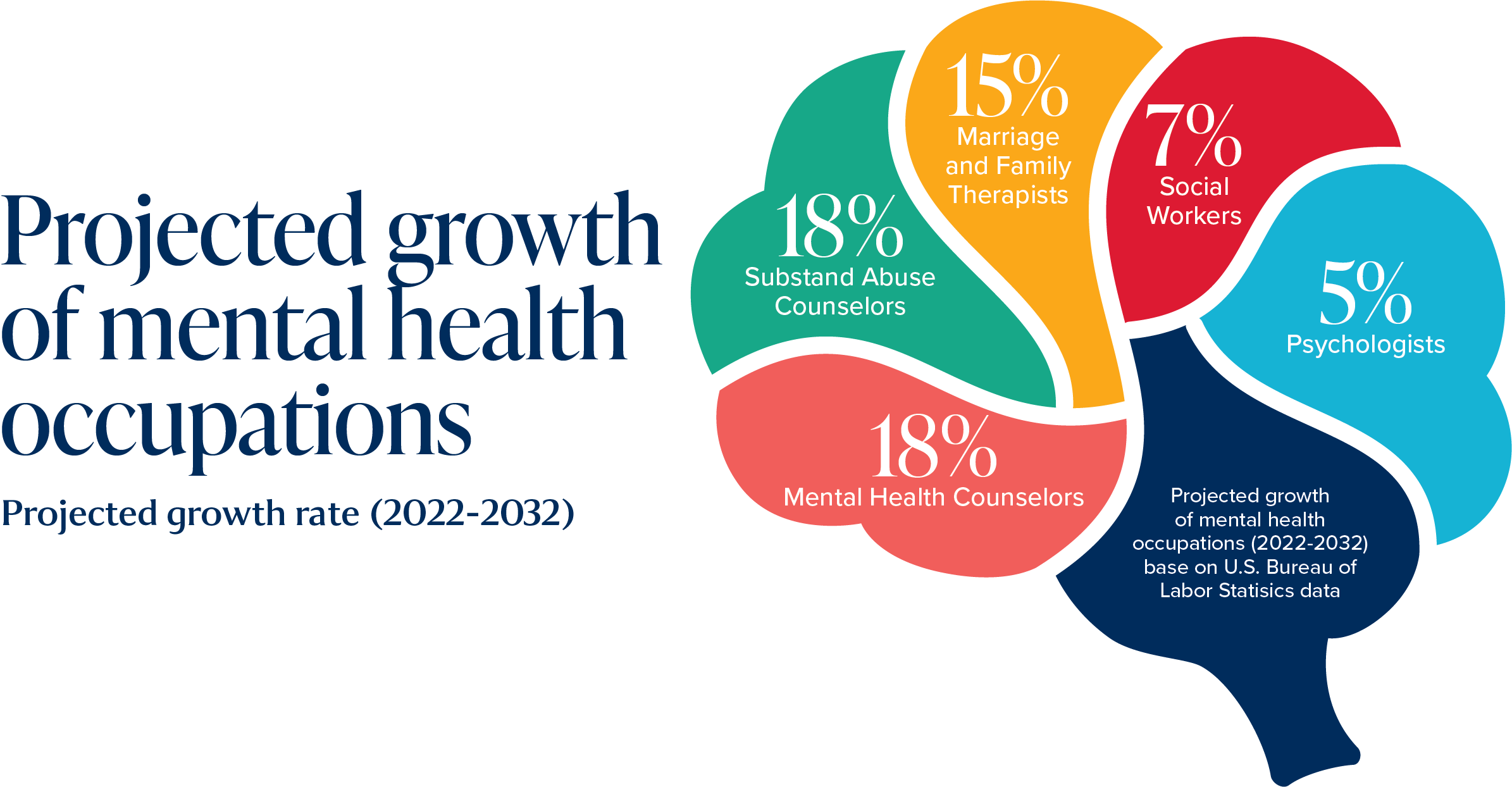
A Saint Mary’s education opens doors to impactful careers in counseling, social work, psychology, and addiction services. These professions offer strong growth, rewarding work, and opportunities to serve individuals, families, and communities.
| Career | What You’ll Do | Projected Growth* |
|---|---|---|
| Licensed Clinical Social Worker (LCSW) | Provide therapy, counseling, and case management for individuals, families, and communities. | 6% |
| Mental Health Counselor / LPCC | Assess, diagnose, and treat mental health challenges; work in schools, clinics, or private practice. | 22% |
| Substance Use / Addiction Counselor | Help individuals and families navigate recovery, develop coping strategies, and prevent relapse. | 17% |
| School Social Worker | Support students’ social, emotional, and behavioral needs within educational settings. | 6% |
| Community Health Advocate | Promote mental wellness and connect clients to services in community organizations. | 10%+ |
| Marriage and Family Therapist (LMFT) | Guide couples, families, and individuals through relationship and behavioral challenges. | 13% |
| Clinical Psychologist | Conduct assessments, provide therapy, and engage in research or teaching in mental health settings. | 8–10% |
| Couples Counselor | Help partners improve communication, resolve conflicts, and strengthen relationships. | 13% |
| School Psychologist | Evaluate and support students’ cognitive, emotional, and social development. | 8% |
| *Projected growth based on U.S. Bureau of Labor Statistics data (2022–2032). | ||
Saint Mary’s University of Minnesota offers flexible, career-focused mental health programs that align with your goals—whether you’re entering the field, advancing your career, or pursuing professional licensure.
Our programs blend academic rigor, hands-on training, and values-based learning to help you become the kind of professional today’s world needs most.
Choose the program that best matches your interests and career goals:
Prepare for advanced licensure and meaningful clinical practice serving individuals, families, and communities.
Specialize in substance use disorders; meet LADC educational requirements.
Prepares for LPCC licensure in Minnesota; learn to assess, diagnose, and treat mental health concerns ethically.
Prepares for LMFT licensure; gain relational and systemic clinical expertise.
Prepare to lead with purpose in a rapidly changing healthcare landscape. Build your leadership, finance, and care delivery skills.
Online program integrating Catholic ethics with evidence-based clinical training; prepares for LPC/LPCC licensure.
APA-accredited program preparing licensed psychologists; extensive practicum and 2,000-hour internship.
To choose the ideal program or path for your goals, consider factors like:
The number one reason people choose a practice-oriented mental health career is to help other people. They pursue this work to make a direct difference in others’ lives, support healthier communities, and do meaningful work that aligns with personal values. Others appreciate the diverse opportunities that are available, such as the many work environments you can work in, including counseling, supervision, consultation, research, vocational assessment, and psychological testing and assessment Others enjoy the flexible work schedules and career security that come with increasing demand.
Depending on your role, you may contribute to prevention efforts, community education, crisis support, workplace well-being, or broader systems change. Other options include group counseling, supervision, diagnostic interviewing, outreach, vocational assessments, and interdisciplinary interventions. We train students according to American Psychological Association (APA) accreditation standards, which put a primacy on well-rounded skills, so our students are prepared for a wide variety of roles.
Saint Mary’s University of Minnesota maintains supervised field placements and practicums across the U.S. Students work one-on-one with field education coordinators to select a placement that meets their needs and career goals.
Many careers in mental health require becoming licensed, including:
To be successful in mental health careers, vital qualities, such as empathy, active listening, patience, cultural humility, strong boundaries, and a willingness to keep learning, are all assets in this field. Being analytical, a good consumer of research, conscientious and open-minded, growth-oriented, self-reflective and self-aware, resilient and persevering, maintaining good personal health – all these traits help you thrive in mental health careers.
Saint Mary’s University of Minnesota accepts various types of financial aid for qualified students, including federal loans and grants. We also offer scholarships to employees of our Trusted Partnership program. The Clinical Psychology program has a scholarship with the Catholic Psychotherapy Association, where you can join as a student member and automatically qualify for a Trusted Partnership scholarship. Speak to a financial aid advisor to learn more about aid opportunities and eligibility.
Saint Mary’s University of Minnesota maintains field placements across the U.S., helping students complete their clinical hours close to home if they do not live near our campus.