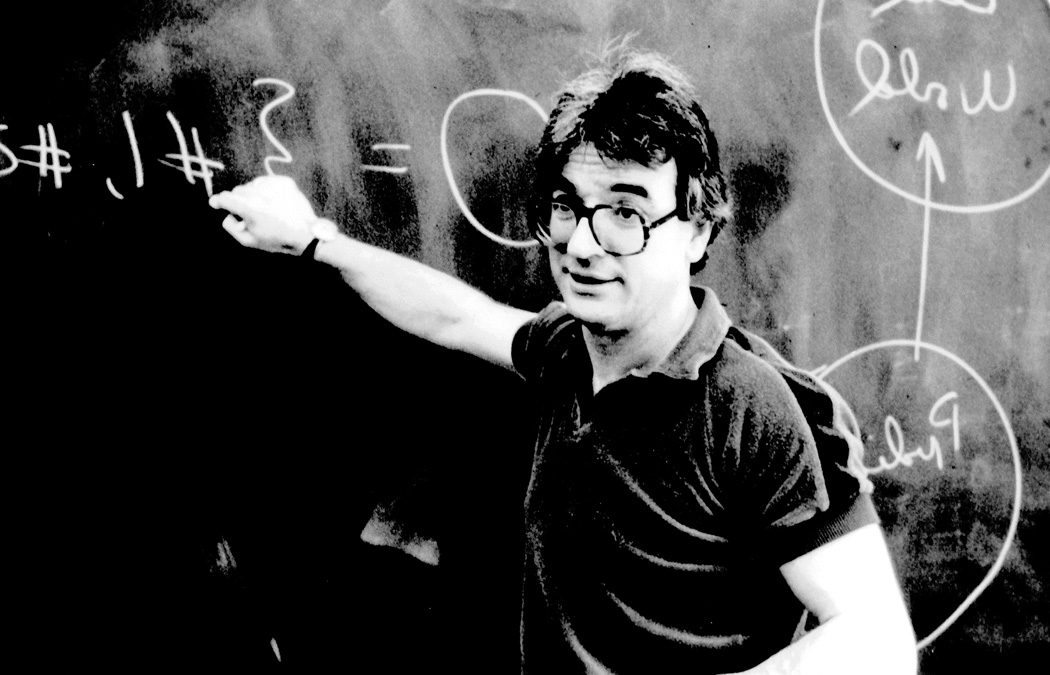
Looking back on his 48-year mathematics teaching career, Paul A. Froeschl B’67, Ph.D., has much to be proud of.
First, he factors in the large number of students who have gone on to obtain their Ph.D.s in mathematics, and then he multiplies that by those he has helped to better understand the subject through one of his books, “Mathematics is Not a Four-Letter Word.” But a highlight of the equation is definitely having two mathematics theorems, Froeschl Theorem I and II, named in his honor.
Dr. Froeschl has been doing mathematics calculations most of his life. In fact, his mother can prove he announced he was going to be a mathematics teacher in junior high school. In high school, a Catholic nun who taught him everything from mathematics to English to Latin, impressed him with her teaching style and solidified that he wanted to teach.
When it was time for college, his father chose a number of Roman Catholic colleges for Dr. Froeschl to consider, and he chose the one farthest away, which happened to be Saint Mary’s (then) College in Winona.
He graduated from Saint Mary’s in 1967 with his mathematics major, along with four ranging minors including English, Russian, Music, and one he forgets. It was his adviser, Bill Franzen, who convinced him that he didn’t want to teach high school, but instead wanted to be a professor.
“He was exactly right. I had never even thought about it,” Dr. Froeschl said.
It was a tumultuous time in the world in the late 1960s, with the Vietnam War raging. Dr. Froeschl, like many students, were concerned about being drafted.
After taking his graduate school exams, as well as one offered by the federal government, he received his scores in mathematics and discovered he was in the top 8 percent of people in the country — which certainly helped with graduate school acceptance.
As a graduation present, his mother paid for his summer school, so Dr. Froeschl could continue courses as quickly as possible at the University of Missouri. After receiving his master’s degree, he feared again he would be sent off to war, but to his relief, he discovered that teachers were be waved, so he asked Brother Leo Northam, FSC, at Saint Mary’s to see if he knew of anywhere needing a mathematics teacher, and — as luck would have it — his alma mater was hiring.
After teaching at Saint Mary’s for three years, as well as serving as the church organist, he was granted two years off to obtain his Ph.D.
After earning his doctorate, Dr. Froeschl returned to Saint Mary’s (where he also advised the music fraternity Phi Mu Alpha) and was working on publishing a paper while teaching. He had been advised to put problems he could not solve at the end of his paper, so he included one that had been challenging him.
“When you submit a paper to a magazine, they bring in someone else in to make sure it is mathematically correct, but you don’t know who it is,” Dr. Froeschl explained. He later found out his proof reader was Dr. Carl Faith, a renowned mathematician, who was so intrigued by Dr. Froeschl’s problem, he spent the next seven years working on it.
Eventually the American Mathematical Society asked Dr. Faith to produce a book, and in this book two theorems were named after Dr. Froeschl, who tries to explain the abstract algebra theorem in layman’s terms. “The whole point is a chained ring is a structure and substructures of it all line up in a row. That’s what you want to have happen,” he said.
He then brought up zero divisors, which are defined as “a non-zero element \\( r \\) in a ring such that there exists another non-zero element \\( r’ \\) in the same ring for which the product \\( rr’ = 0 \\).”
He adds, “What happens is you look for those things, those zero divisors. If they’re at a certain ring, then the big ring above it will be just as nice as the one below. And it goes the other way around. The other theorem says what if it doesn’t chain, it turns out there’s two chains in the lower ring, so it’s not quite as nice as the other one.”
When he heard about the honor, Dr. Froeschl looked up Dr. Faith’s book on Amazon. He eventually found the book in the library at the University of Minnesota, where he later worked, and was able to make a copy. When he moved to Fort Lauderdale, Fla., he had it framed, and it now hangs in his living room.
After teaching at Saint Mary’s for 23 years, he then taught at the University of Minnesota and Macalester College for another 25 years.
But teaching wasn’t just confined to the classroom. In addition to writing four textbooks, he wrote a bedside book, “Mathematics is Not a Four Letter Word,” which was aimed at tricking people who didn’t think they could understand mathematics into realizing they could.
He said there have been points in his life where he couldn’t sleep or function because he was thinking about mathematics all the time.
But the highest compliment was when he heard a former student say, “This guy really knows how to teach calculus.”
“I had a great time teaching,” he said. “I’ve stayed close with a lot of (my students).”