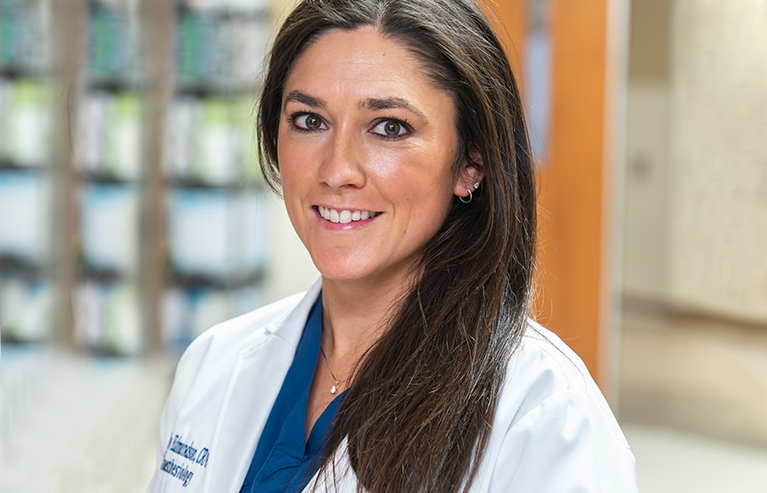
Every day when Carmen Drentlaw D’24 goes to work at Cuyuna Regional Medical Center (CRMC) in Crosby, Minn., she has no idea what she’ll face, but that’s exactly why she decided to pursue a DNP (Doctor of Nursing Practice) in Nurse Anesthesiology from Saint Mary’s University — so she could be qualified and competent in a variety of situations.
“What I love most is that every day is a little different, and I get to meet so many people,” she said. “Everyone having surgery is very nervous and also excited to get their surgeries done. I get to help them work through some anxiety they’re having or a difficult process. I like the challenge. I get to learn new things and do different procedures.”
Dr. Drentlaw graduated in August 2024, with Saint Mary’s first DNP class. Following graduation, she successfully passed her national board examination and became a Certified Registered Nurse Anesthetist (CRNA). Just two years out of school, she already faced an emergency situation during a birth, but she relied on her education and her experience to care for her patients.
She explains that while providing anesthesiology services during an emergency cesarean section, suddenly both the mother and the baby were in distress. Until additional help could arrive, Dr. Drentlaw successfully cared for both patients simultaneously.
“Patients who seem fine can turn,” she said. “Working in a critical care access hospital, we don’t have the resources other facilities do, but I was able to utilize what I have learned in school, and I was able to help both of them, and everyone turned out fine. It was a scary moment as a new CRNA, because you don’t get to practice some of these things in school. You have to utilize your education and your resources around you.
“Everyone in our hospital is very well trained. We were able to get an ER physician to join us right away, but it takes time for them to get there, so until then, I had to split my attention. You can’t leave mom without a provider, but there’s also a baby needing help, so you have to give direction and communicate with people, using other individuals as your eyes. That way I could be in two places at once.” Working in a small community, she added that knowing the mom increased the anxiety of that moment. Additionally, the patient’s husband was in the room watching everything unfold.
Dr. Drentlaw knows that providing CRNA in a rural hospital, these situations can arise. That’s part of the reason why she chose both this particular profession and her location — a rural facility that needs her the most.
After obtaining her nursing degree, she was working in the ICU at Abbott Northwestern Hospital in Minneapolis, when she had an opportunity to serve as an anesthesia aid. From this exposure working alongside CRNAs, Dr. Drentlaw knew she was interested in pursuing that pathway.
She discovered she was working with CRNA graduates from Saint Mary’s — as well as current Saint Mary’s students who were doing their clinical rotations — and they all recommended the university. “Just talking to them, I would hear how great it was,” she said.
Then, as she applied to Saint Mary’s, she discovered that the university was transitioning its former Master’s in Nurse Anesthesia program to a comprehensive Doctor of Nursing Practice (DNP) in Nurse Anesthesiology. “I figured why not go for the doctoral program,” she said, explaining that newly entering nurse anesthesia students are required to enroll in a doctoral-level program, and if she ever wants to pivot and teach, she’s glad to have her doctorate.
She enjoyed working alongside the other DNP students and the professors. “They did such a good job of putting our class together. Our personalities meshed well,” she said. “Our professors made it so much fun to learn. Everybody wanted to be there, and we all wanted to help each other succeed. And then on top of that the clinical rotations were just great.”
Because Dr. Drentlaw wanted to work in a rural setting, she was excited to hear the university had many affiliations with rural clinics. And, she says there are not many programs in Minnesota that allow students to choose locations of their clinical rotations like Saint Mary’s. “Our professors work super hard to make that happen. I knew I wanted to do the rural rotations and would come out well versed,” she said. “I grew up in a rural community, and I knew I would come out of the program, doctorally trained and able to practice to my full abilities. “At critical access hospitals like ours, recruiting and retaining CRNAs can be challenging because the role often includes broader responsibilities, more frequent call requirements, and less predictable time off. Despite those demands, I truly enjoy the opportunity to practice to the full extent of my education, training, and professional authority.”