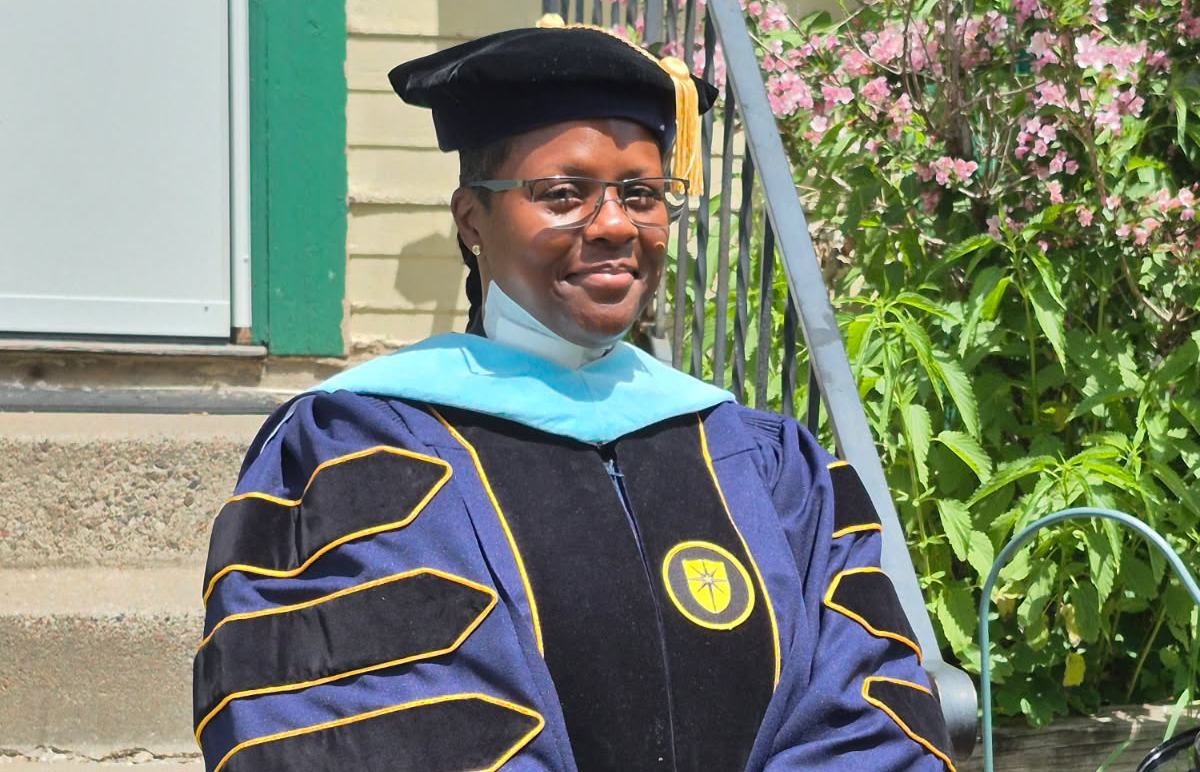
Lydia Majors-Roland M’13, D’26 — as co-founder and co-CEO of Ainga Mental Health and Consulting in Minneapolis — says the best part of her job is seeing the transformation that occurs with her clients … and her staff.
Dr. Majors-Roland explained that although the organization employs licensed mental health professionals, she also mentors clinical trainees who are working toward licensure.
“For me, it is that transformation with our staff when they are observing that change in their clients,” she said. “You see the skills you have been teaching them. They are witnessing life transformation.”
Fittingly, Dr. Majors-Roland says Ainga is a Samoan word that means family and extended family. The mental health clinic in Minneapolis is largely virtual. It started during the COVID pandemic in order to provide services to clients who couldn’t leave their homes. Still virtually serving underserved communities six years later, the business now has added a small office in downtown Saint Paul. She also co-owns a substance abuse center in downtown Minneapolis.
“In the substance abuse center, we had our first graduation last week, and it was the most beautiful and emotional time,” she said. “We had one client who, when he started our program, was aversive, saying ‘I don’t need help; I’m only here because I have to be.’ But then, at graduation, seeing the progress he made was nothing short of amazing. He’s using the skills he learned and going to different support groups and coming back to be a voice of reason and a leader in the community. He’s now supporting others and showing them what can be done. That is the piece of my work I love the most. We don’t make a lot of money in social services but that is worth so much more than money.”
Dr. Majors-Roland first found Saint Mary’s for her M.A. in Counseling Psychology degree, which she earned in 2013. She’d never heard of Saint Mary’s, but upon further investigation, she learned that taking the GRE (Graduate Record Examinations) wasn’t necessary for admission, which was a big perk. And, she was encouraged to see that a diverse population of students attended the Lasallian Catholic school.
Years later, she returned to Saint Mary’s to get her Doctor of Education in Leadership. Friends of hers were attending a similar program at another school, but Dr. Majors-Roland was thrilled to find out Saint Mary’s also offered it.
“I already loved Saint Mary’s anyway, the smaller class sizes, the intimacy of the campus,” she said. “Everything is right there. You can go from one building to another right down the street. It felt really homey. You don’t have to go far to get your needs met. Everyone is so welcoming, and I had really good professors who were very helpful and very influential about me coming back for my doctorate. I needed the program to be work and homelife friendly.”
Dr. Majors-Roland appreciated that what she was learning was applicable in her work, particularly as a co-CEO. “I’ve learned so much about leadership and how to be an exceptional leader,” she said. “I think I’m a great leader, but I also have all the tools from those courses to be an exceptional leader. I feel like I am always teachable. And I feel like what they taught is applicable across many genres of work: mental health, corporate America, the health system, law. It’s transferable.”
There were two main reasons Dr. Majors-Roland felt compelled to get a doctorate:
“My initial reason was I told my grandfather I was going to be somebody, and I told him I was going to be a doctor one day, and make him proud,” she said. Though he passed away in 2016, Dr. Majors-Roland remembered her promise. “He taught me a lot. I felt the need to not let him down. He showed up in a way that changed my outlook on life.”
Additionally, she knew the added credentials would help her better serve her clients. Prior to Ainga, she worked as a children’s mental health case manager for Ramsey County for seven years.
“I would go to Saint Paul public schools all the time to advocate for the kids I was working with, and one of the biggest problems I see in the schools is the IEP (Individualized Education Plans) and how so many educators and social workers were pushing off diagnoses at a disproportionate rate, particularly in the African American Black community, giving them behavioral IEP diagnoses.
“These behaviors come from somewhere. They aren’t just acting out to be acting out. There is an underlying cause,” she said. “I felt like I had to fight a whole lot harder than my co-workers who were white. I had to show up differently. I had to voice my opinions differently. I knew the only way I was going to combat this was to get an education and show them I knew what I was talking about.
“I made some allies who saw where I was coming from and aligned with me to further advocate for these students and get them services they deserved. They and their families had hope now.”
Dr. Majors-Roland will soon add one more title to her list of responsibilities. She will be returning to Saint Mary’s to volunteer as a peer support specialist. “I’m coming back because I loved it so much. I quit 10 times in my head, so I want others who are struggling to have support from someone who has gone through it.
“I would absolutely recommend Saint Mary’s and have,” she said. “The people are the most genuine, helpful, and amazing. I’ve met so many friends and mentors there — people I have learned so much from, and not just professors. And it’s so accessible; it’s working-adult friendly because you can go to school at night or online. Those are the things that kept me coming back.”