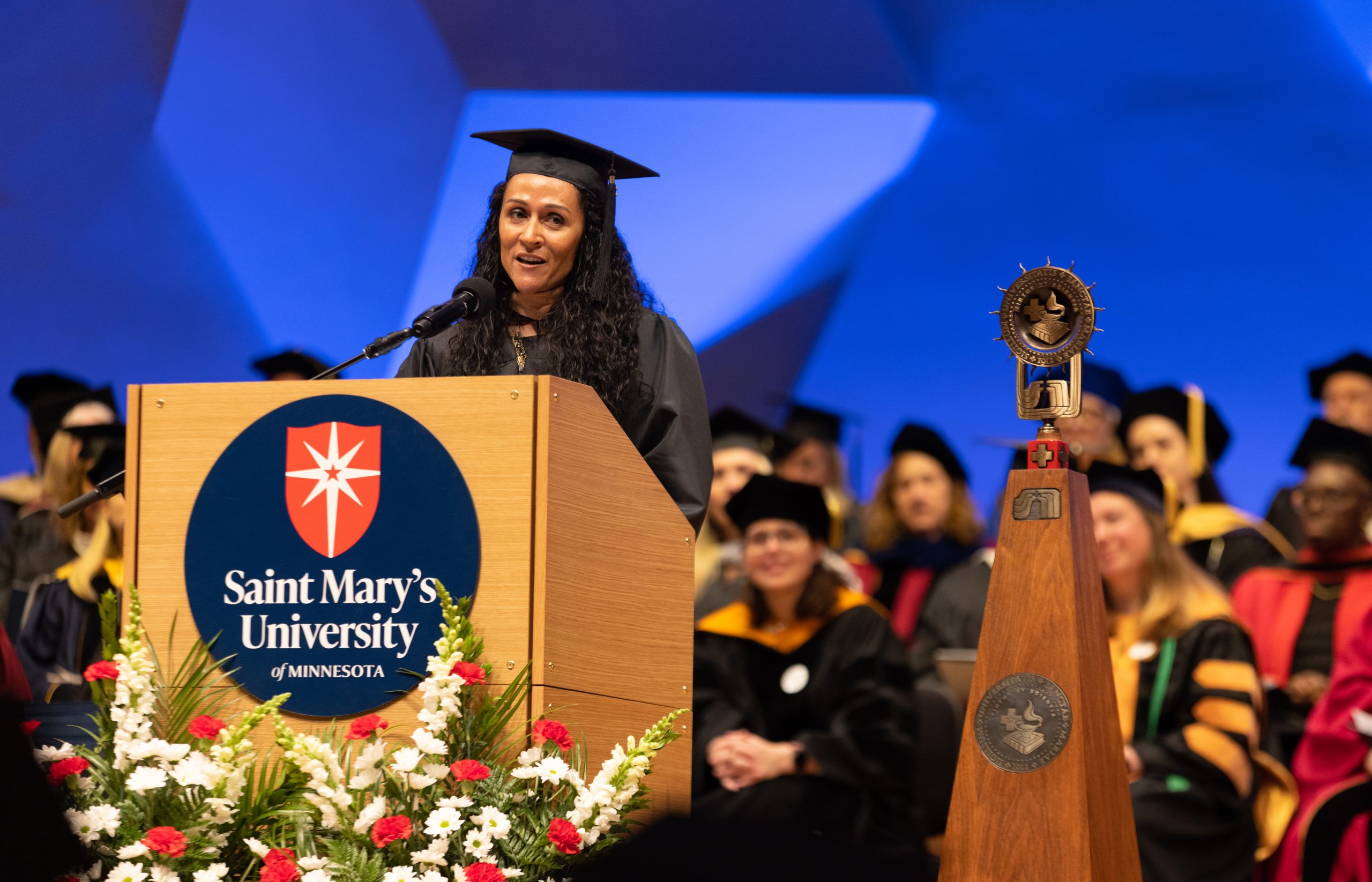
Programs adapt to needs of adult learners
Janet Byrnes earned her Master’s in Health and Human Services Administration in 1985. Her first courses were held at what is now M Health Fairview St. John’s Hospital and, about halfway through, she transferred to Saint Mary’s newly established graduate campus in Minneapolis.
Nearly 40 years later, in 2024, Melissa Markfort received her MBA from Saint Mary’s by attending online courses.
Though the method of learning and timeframe was very different for these alumnae, they share similar stories and experiences.
Janet Byrnes M’85
Byrnes had just earned her undergraduate degree and was having trouble finding a full-time job. “I was working with my husband at an orthopedic clinic part time, doing cleaning,” she said. “One of the doctors there told me about the (Saint Mary’s) program, and I thought it was interesting. I thought I might as well go back to school.”
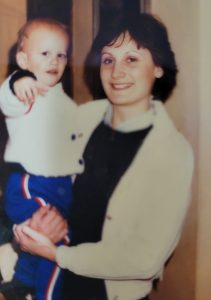
An undergraduate psychology major, she originally wanted to go into therapy; she thought a degree in health and human services was a nice blend of her interests and would help her work toward a future in administration.
She doesn’t recall many details about what it was like learning on a new campus that was transitioning and growing around her. For Byrnes, the intimate classroom experience is what she remembers the most.
“I attended classes one full Saturday or two a month and one evening a week, so it fit well,” she recalls. “At that time I had a new baby too. I had no complaints about the whole process. It was very positive and welcoming.”
As the youngest in her cohort, Byrnes recalls being one of the few who finished on schedule, which was a morale boost.
“Because I was so fresh out of school, it was all eye opening. I loved the fact that instructors were all working in the field,” she added. “I still remember them so fondly. I would love to connect with some of the people from my cohort. It gave me a really good foundation of information, and sometimes it just helps to have that additional M.A. after your name.”
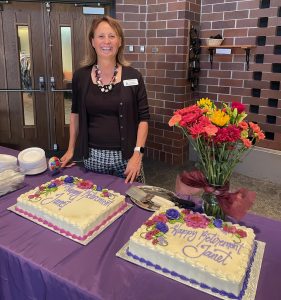
retirement from
Lyngblomsten
Care Center a
year ago
After graduation, Byrnes, who lives in Brooklyn Park, landed a full-time job for six months at a long-term care facility and held her next one for 39 years at Lyngblomsten Care Center. She began as a laundry supervisor and worked her way up the ladder to become the assistant living director and assistant administrator — before retiring a year ago. “I didn’t necessarily need my advanced degree, but having it gave me more credibility, and I certainly got good information,” she said. “I remember some very key things that have carried me all the way through. I was able to obtain my LALD (License for Assisted Living Director) and LNHA (Licensed Nursing Home Administrator) with only a few more classes because of the classes I took at Saint Mary’s.”
Melissa Markfort M’24
As a result of COVID, Melissa Markfort — and countless others — began thinking about getting an advanced degree in their newfound free time at home.
“The idea of it was always there, but the timing was never right,” she said. “But with COVID, we had this time on our hands, and I heard lots of people were going back. I still sat with it for about a year. I thought about where I was in my life in terms of my life, career, and family and thought, ‘Things will only continue to get more intense. If I wait for the right time, it will never get here.’ I had to build in some disciplines and guardrails to protect me from myself and help me reach my goal.”
When she started researching MBA programs, she discovered she knew a lot of alumni from Saint Mary’s. “When I started diving into research, it was very important to me that the institution have a diverse student work force and a proven track record in honoring flexible learning, knowing it was something I would absolutely need,” she said.
A wife and mother of two (in elementary and middle school) living in Robbinsdale, Minn., Markfort was in her late 30s and was also working full time. She knew online courses were the perfect way to help her reach her goals. Still, she got up at 4:30 a.m. to get her classwork done.
“But I didn’t stop living,” she said. “I didn’t stop showing up in these spaces. I would take group calls from hockey tournaments and write my organizational leadership papers while sitting on a cruise ship west of Cabo. It was about the balance of all of it.
“I ended up being able to pace myself,” she added. “What I appreciated the most was being able to reflect on what went well and didn’t go well each semester and carve out small changes.” One particular summer, there was so much going on in her personal life, she took a 1 credit course that spanned 16 weeks, so she could stay engaged and in student mode but still balance her life.
She also appreciated that what she was experiencing professionally and what she was learning overlapped. “I would immediately turn around and apply what I was learning into everyday practice,” she said. It even changed not only the trajectory of her career, but also her career itself.
She describes one of her courses as rocking her to her core. “In my previous for-profit organization, I was offered a VP position, and I ended up turning it down because I realized that being intrinsically tied to the work I was doing was something that really mattered to me. A year from finishing my degree, I paused to think about what I actually wanted to do with it. I ended up looking for mission-driven organizations as contenders for future employment.”
She found Children’s Minnesota — Minneapolis Hospital, and six months from graduating with her MBA, she was promoted to her dream job as director of employed provider practice.
“This is my favorite job ever. I get to partner with hospital chiefs and leaders. In my portfolio, I have 625 physicians and advanced practice providers who are impacted by my work,” she said, explaining that she deals with provider experience, governance structure, improvements, and other crucial areas in which she helps them have a voice at the table. “It’s a really rewarding gig. I report to the CEO. They look to me when navigating important and critical workforce cultural crossroads. I’m advancing work that defines who we want to be in the future.
“The fact that I pivoted in my career toward a place where I feel like I’m part of something bigger is such a huge gift,” she added. “It was this reckoning that the degree did for me.”