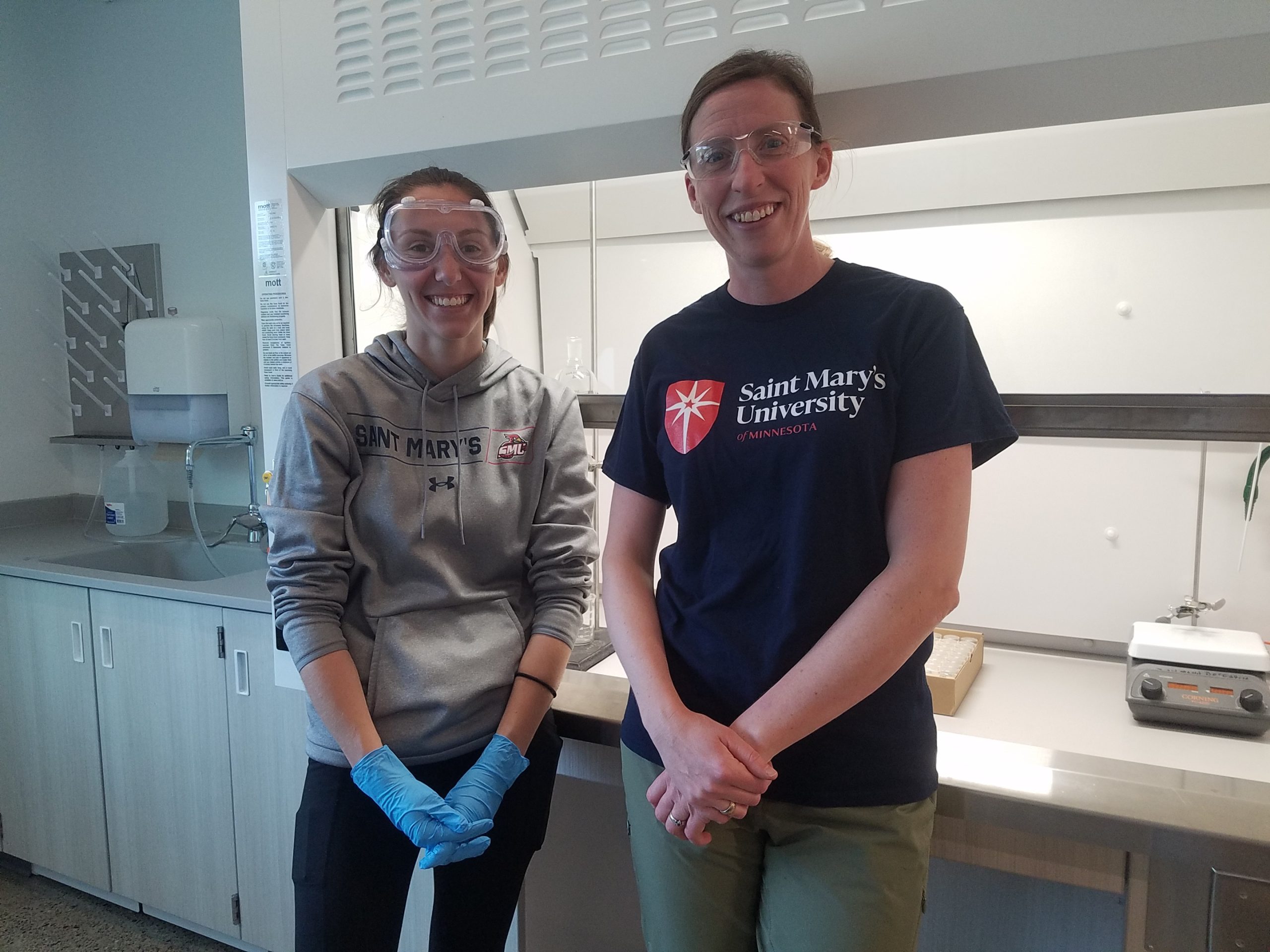
What started out as an accidental discovery culminated in 10 years of research, grant-writing, and drafting for Heidi Dahlmann, D.S., associate professor in the Department of Chemistry and Biochemistry at Saint Mary’s — and her undergraduate students.
As the ultimate validation, their research, titled “Phosphoric Acid Derivative-Catalyzed Carbonyl-Olefin Metathesis,” has been published in Organics, an international, peer-reviewed, open access journal published quarterly online by the Multidisciplinary Digital Publishing Institute (MDPI).
Ten undergraduate researchers, including Saint Mary’s Alyssa Jones B’25, Nick Ryan B’23, and Evan Vazquez ’26, are among the co-authors (with another nine students acknowledged, including Saint Mary’s Rachel Szepieniec B’25).
The abstract states, “Ring-closing carbonyl-olefin metathesis (COM) reactions provide a straightforward method for producing cyclic alkenes from precursors containing carbonyl functional groups tethered to nucleophilic alkenes. Within the last decade, many methods for carrying out Lewis acid- or organocatalyzed COM reactions were reported; however, Brønsted–Lowry acid-catalyzed COM reactions are less developed. Herein, we report that phosphoric acid derivatives and N-triflylphosphoramides mediate COM reactions, although the substrate scope is limited to biaryl compounds that cyclize to produce phenanthrene products. We also disclose the synthesis and characterization of a previously non-fully characterized phosphoric acid derivative and a novel phosphoramide.”
Dr. Dahlmann explains what that means in layman’s terms. “To break it down in the most simple way possible, you would start by taking a molecule that can kind of stretch out in a straight line, and, on one end, there’s going to be a carbon-oxygen double bond, and on the other end, there’s going to be a carbon-carbon double bond, and what we discovered by accident, really, was a set of reaction conditions where they would loop together and fuse to form a cyclic molecule. That process was called carbonyl-olefin metathesis, and this is something that seldom happens in nature on its own. It’s a technique that synthetic chemists will use if they want to make a cyclic molecule on purpose, but it really doesn’t have such a common counterpart in nature, so it kind of makes it useful when you want to have a shortcut to making a cyclic molecule.”
While doing post-doctoral teaching in Georgia, Dr. Dahlmann was researching a separate reaction and found this cyclic molecule, which at the time, she couldn’t explain.
“I knew it had happened but it was too early to tell anyone about it,” she said. Then, in 2016, she happened to be flipping through an industry magazine and saw an image of a similar reaction. “At the time, Corinna Schindler (a researcher from the University of Michigan) claimed that she had tried types of catalysts similar to the one that I had used, and none of them had worked. So the consensus was that her conditions work, and the type of acid that I was using wouldn’t, and I was like, but it does. I thought, if she could publish that paper in Nature (a high profile journal), maybe I was onto something too.”
Dr. Dahlmann has involved students in her research from the beginning. She said she chose a teaching versus research post doctorate on purpose. “Ever since I was an undergrad, I have really loved explaining chemistry and I wanted to go on to teach at a smaller college where I would get to teach a lot and interact with students,” she said.
She described working on this research with students as “living the dream.”
She explains that giving undergraduates the chance to work on a real research project, where there isn’t a preplanned result is important. “It’s taking a basic technique they learn in class and applying it,” she said, adding, “But it’s about having to think through things on your own. If something doesn’t work, you have to troubleshoot or look for why. It’s a completely different experience than they get in an undergraduate classroom setting.
“If they’re pursuing a career in science, they have to learn that things do not usually work. They have to deal with that frustration, and realize how cool it is when something does work. It’s an on-switch for some students and an off-switch for others. Those students have happily moved into pre-med or other professional programs.”
A couple of students presented their research at regional and national conferences.
Throughout the past decade, though some of her former students have now gone onto graduate school and post-doctorate research, Dr. Dahlmann has stayed in touch with them throughout the process. She said they were valuable throughout the editing process as well.
Getting published is the ultimate achievement, and for students and alumni to have their names attached to the article is a great CV builder. “It’s very eye-catching when they’re applying for fellowships and scholarships and getting into more intensive summer research programs or post-bachelor programs,” she said.
Photo: Dr. Heidi Dahlmann with Alyssa Jones B’25