Alumnae pioneers pave the way
The early years of women’s athletics at Saint Mary’s can best be described as “cobbled together.” There were no concession stands, and though supported, the bleachers weren’t always full, particularly for volleyball and softball. Admittedly, they weren’t winning much in those early years, and many of the coaches weren’t exactly seasoned professionals. Jockeying for facilities with men’s sports was contentious, and the athletes themselves often did most of the recruiting and set up.
But those first women — determined, creative, and resilient — did what they had to in order to compete.
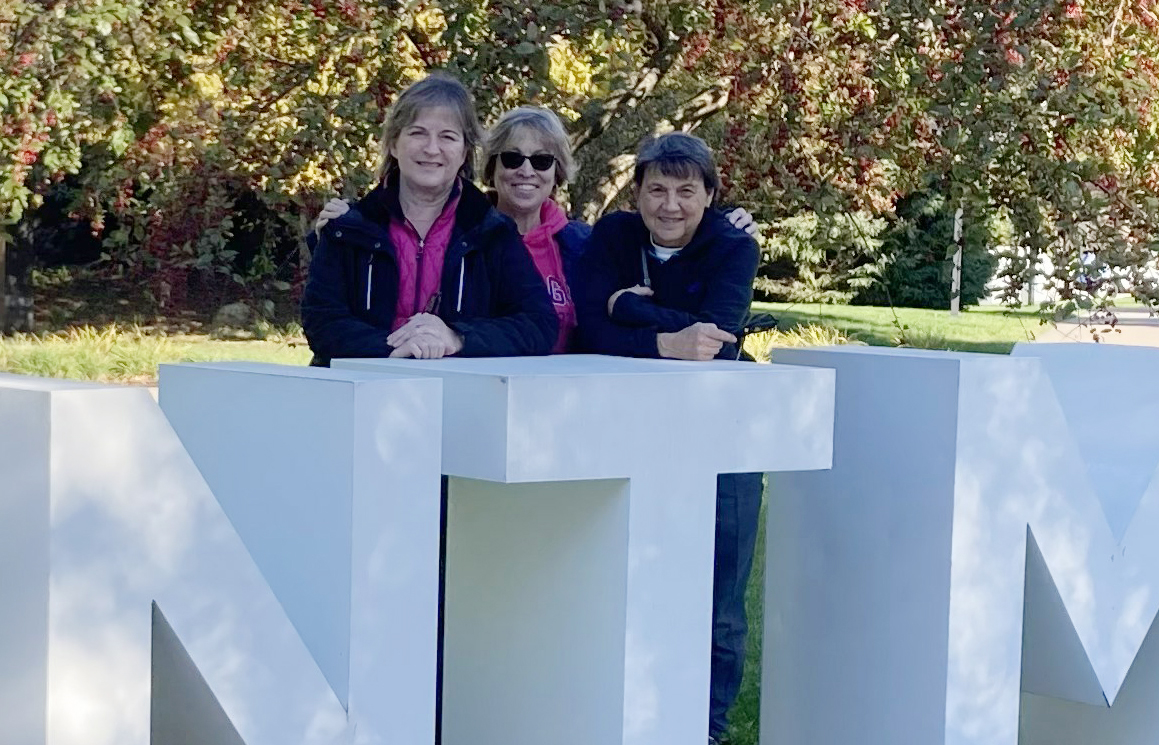
This is the story of some of those pioneering women at Saint Mary’s: Bruna Bucciarelli B’76 (basketball, cross country, and volleyball), Jane (Troller) Wood B’78 (softball and volleyball), and Marge Nabzdyk ’79 (softball and volleyball).
Although Title IX — which prohibited sex-based discrimination in any education program or activity receiving federal financial assistance — was signed into law in 1972, it took a while for things to run smoothly for female athletes at Saint Mary’s.
In 1974, Saint Mary’s first sport, women’s basketball, began a year after Bucciarelli transferred in. The team was coached by two seniors from cross-town Winona State. “It was very grassroots,” she admits. “They were basically our age. We didn’t realize it, because we didn’t make that connection.”
Just being part of the team helped Bucciarelli assimilate to her new school. “I think what it did was make you feel part of a group. You only hung out with certain people in class or in your dorm, so your social group was small. On a team, you were one. You played together as a team and you felt part of a greater community.
“That’s how I started feeling part of Saint Mary’s.”
Bucciarelli believes cross country was just a club in 1973 when she transferred in. “I asked Dr. Richard Jarvinen, ‘Can I run with you guys?’ And he was so accepting and just allowed me to be a part of the whole group. There weren’t many women, so I had to run with the guys. I did not win at any of the races, just in case you were wondering,” she said with a laugh.
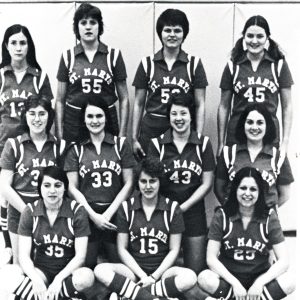
featuring Bruna Buccarelli B’76 as No. 35, front left.
By 1974, Wood also came to Saint Mary’s. As a student, she was named manager and trainer of the women’s basketball team. She learned to tape shin splints, but had no other official training. By 1975, when volleyball began, her qualifications earned her a spot as the trainer for that sport as well.
Also in 1975, women’s tennis and softball teams were formed. Gail James — described as a “short fireplug who didn’t take crap” — was hired to coordinate Title IX so Saint Mary’s was in compliance with legislation regarding scheduling practice times, locker rooms, facilities, etc.
“She fought very hard for our teams, including helping women’s sports to be noticed and respected at Saint Mary’s,” Nabzdyk said, explaining that the women had to share spaces for practice with the men, including the gymnasium. “The guys thought it was really funny that we were assigned from 5:30-7 a.m. But we got up and did our thing for two weeks until Gail went to the men’s coach and said, ‘For the next two weeks, you have the gym at 5:30 and (the women) will have it in the afternoon. The guys didn’t think it was quite so funny anymore.”
That first year, tennis was coached by the men’s hockey coach, and volleyball was coached by a man who wore cowboy boots to practices and had never coached before. As a man who had played a sport, Bucciarelli said he was likely considered qualified back then. Wood and Bucciarelli were on that first team and remember they weren’t very good. But back then, it wasn’t as much about winning as having the opportunity to play.
“There was really nothing for women to do at Saint Mary’s, so having this opportunity kind of opened up our world,” Bucciarelli said. “The women at Saint Mary’s were hungry to do something as opposed to just going out on Saturday night.”
Wood explains that in the ’70s, the drinking age was 19, so the bar scene or keggers were popular on weekends, but they wanted something more. “Sports were another avenue for us to grow,” she said. “It was just exciting to be part of it, but a lot of the excitement was for us. It’s not like now where students are so used to having access to sports in high school, being good, and maybe even getting scholarships. We were just happy to be playing.”
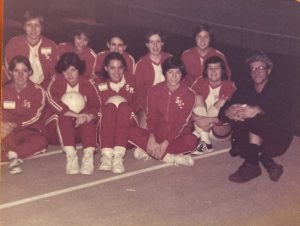
Haas B’79, Retsey (Ronk) Anderson B’80, Susan (Kauth) Ruen ’80, Jane (Troller) Wood B’78, Patricia (Berges) Karnick B’79, and Coach Jeffrey Kohner B’57; second row, Susan (Ruszkowski) Wilson B’79, Debra “Debbie” (Moore) Kummer B’80, Karen M. Oaster B’77, Mary Beth (O’Loughlin) Husfield B’80, and
Margaret “Marge” Nabzdyk ’79.
In 1975 and the subsequent years, women’s softball was coached by Ken Wiltgen. Wood played, and Nabzdyk became the pitcher when she arrived at Saint Mary’s in 1975 (and she also played volleyball). Her qualifications, Nabzdyk said, were that she’d played powderpuff softball without a mitt in high school, but she had a glove and said she’d give it a whirl. “The coach asked if anyone could get a ball over the plate, and I told them, ‘I can get it over, but it’s going to have an arc on it,’ and he said, ‘You’re up.’ Whenever someone would step up to the plate, they’d smack the heck out of it because it came in slower than molasses.”
Nabzdyk’s work-study duties were to wash uniforms, carry around equipment, and make sure everything was in place for games. “We did whatever we had to do to make our team happen,” she said. “Jane was the recruiter, when she would bring people in (to visit campus through admissions through her work-study position), she would ask, ‘Do you play volleyball or softball? Would you be interested in being on our women’s teams?’”
“We got to play our games on the guys’ practice field with a portable backstop and Marge and I chalking the lines,” Wood added. “We were starting from scratch. Most of us were new to sports. We were learning new skills, but it was exciting and something new, and we got to participate.”
Bucciarelli was inducted into the Sports Hall of Fame in 2023 for her pioneering work in those early years for women, but she wants to share the spotlight with Wood and Nabzdyk, and others, without whom women’s athletics wouldn’t be where it is today. She hopes one day this group will be recognized for their work in some way.
“I don’t feel like I did anything out of the ordinary back then. Only now I’m realizing what we did for Saint Mary’s,” Nabzdyk said. “We just went about our business to get the job done. Now we are realizing the impact we had on women’s sports.”
Wood added, “It contributed to our resiliency. You just had to keep going. Some of the young ladies must think, ‘How could you put up with that?’ We didn’t know any different, so we just kept going forward. It was a door being opened to us.”
The best part of those years for all three is the camaraderie — in short, each other. All three, living in different states, get together regularly and connect with other teammates. “It solidified our relationship,” Bucciarelli said, adding, “It gave you confidence to learn new skills. And when we traveled to different places, our world expanded. It was those first steps to seeing the world in a bigger view.
“What helped me was the positive, reinforcing feelings that the Saint Mary’s community gave us. It just created a feeling that I was doing something good for me, but also good for the community and something to make people happy.”
Lettner grateful for alumnae whose tenacity benefited future athletes
Lindsey Lettner B’26, an accounting and business intelligence major, graduated in May. With much to look back on during her college career, her basketball team winning the first MIAC playoff game in the quarterfinals is at the top of her list. Though they lost in the semifinals, they received an at-large NCAA bid because of their record and competition. Though they lost in the first round, they’re all memories she wouldn’t trade.
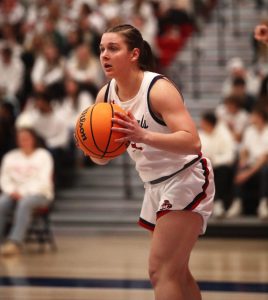
game this year.
Lettner transferred to Saint Mary’s during her sophomore year, largely because of the strength of the accounting department, the community atmosphere, and because her brother also attended. But she said the fact that Saint Mary’s was closer to home was also a draw, because she knew her family could more easily support her at basketball games.
Her team was also the first to play in the new David R. Thies B’59 Arena. “We’re super grateful for David Thies to have donated that to us,” she said. “It really helps with the recruiting process, showing we have these nice facilities, but it’s also nice for the fans to enjoy their experience.”
If Lettner were to meet the “first women” in athletics, she said, she’d begin with a thank you. “They’re the women who came before us and paved the way to do what we love now. A lot of people don’t get the opportunity to play in college,” she said. “It’s a huge support system, having a group of teammates. It’s special that they set the tone for college athletics now. I know they faced more hardships than we did. I think the fact that they were able to get through all the adversity has benefited so many women like myself.”
Athletics, she said, has played a huge role in shaping her as a person. “I’m definitely known to be a hard worker among my peers,” she said. “Having athletics allows me to set goals for myself. It also helps with time management. Athletics makes me a well-rounded, hard worker. It helped me when it came to the interview process. It shows your dedication to balance both your school work and athletics. It indicates that you can take that into your career after college, that you will put extra effort in and go above and beyond.”
Half a century later, the answer to the best part of being in athletics hasn’t changed. “I’d say definitely the team is the best part,” Lettner said, recalling fondly the bus rides after away games after a big win or the team dinners and activities. “Obviously you love your sport, but you become a family that you can depend on.
“The community was another big part of what I loved here. That last game, having students come out and support you makes it even more special,” she added. “Professors were also at every single home game. They’re always emailing after the game or mentioning it in class. It makes it special that everyone wants the best for each other, having that support system and love.”