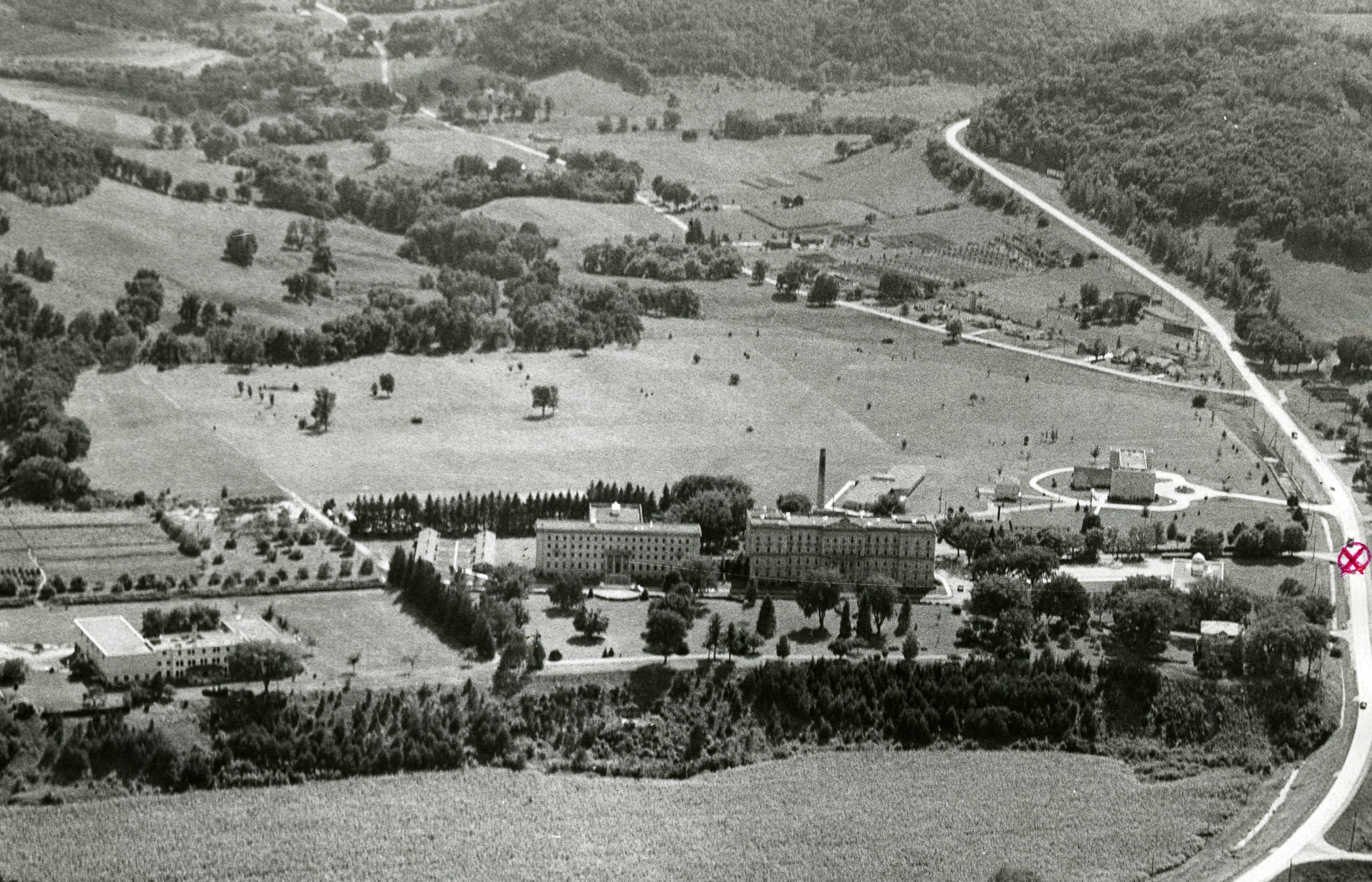
Though much has changed, heart stays the same
Alumni ranging from the classes of 1966 to 2026 discussed the many ways Saint Mary’s has changed through the decades: from pay phones to cell phones, group televisions to one in every room, and curfews — to lifelong friendships, transformational faculty and education, and the community feel that keeps them connected. Reminisce through their stories about all the ways this university has changed and, more importantly, the ways it hasn’t.
Choosing schools
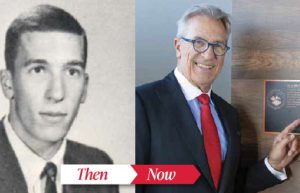
Michael Dooley B’66 and Roger Haydock B’67, J.D. said they never visited Saint Mary’s Winona Campus prior to their arrivals as freshmen. But that wasn’t unusual back then.
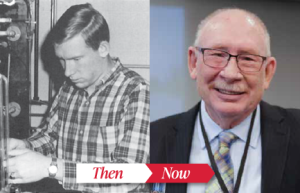
Dooley said he doesn’t remember having any other choice of schools. As he attended a high school affiliated with the Christian Brothers, the continuation to Saint Mary’s (or another Christian Brother college) was more than encouraged. “I remember quite a few from my high school, 12 or 13, came to Saint Mary’s. I never stepped foot on campus until I got here.”
Haydock chose Saint Mary’s because he knew others who were attending. “I was attending Archbishop Quigley Preparatory Seminary in Chicago along with Robert Wheeler B’67. In April of our senior year, we decided not to continue on to minor seminary.
“Minnesota was the land of sky blue waters and a lovely place for a kid from Chicago. And Winona with the river and its bluffs was picturesque — as was the campus. I had just looked at pictures; I didn’t visit it, but Bob and I agreed to become roommates. I had a cousin going to Saint Mary’s as well, and I knew some other people. I have no recollection of looking elsewhere. There were no college trips or anything back then; the first time I saw campus was when my parents slowed the car down. I got out with a big suitcase, and they left,” he said with a laugh. “I wanted to go to a smaller, Catholic university, and it just fit.”
By the time Joseph “Joe” Sweeney B’81 chose Saint Mary’s, there were more options, and he was able to visit and decide if Saint Mary’s was a good fit. It came down to one important difference between schools. “I was in my senior year of high school, and I was leaving the house to go to a party one night when my mother said, ‘Joe, you need to pick a college for next year.’ She had every college correspondence we’d received in the mail sitting on the table. I went through it all, and the correspondence from Saint Mary’s was the only one with a letter signed in ink by Dr. John Johnson.” Based on that, he and his family toured the Winona Campus. “I’m an outdoorsman, I love to trout fish, ski, and be outdoors. All that was available. Saint Mary’s was a good fit for me.”
Javier Rodriguez Cifuentes B’26 doesn’t exactly fit the mold of most university students who visit an average of 10 schools (looking for whether it’s a good fit, fun, and have the majors they’re looking to study) before choosing one. Cifuentes transferred into Saint Mary’s during his sophomore year after receiving his associate’s degree. He never visited campus prior to orientation day, but he did his research.
“I was doing my own research to uncover what schools offered the opportunity to learn in a P.A. (physician assistant) program, and then it came down to financial aid and which schools would help me be able to achieve that goal realistically without going into a large amount of debt,” he said. “I knew about Saint Mary’s physician assistant program. I knew their education had a good reputation.”
For Cifuentes, his main focus was on academics. “I figured wherever I go, I’ll make it work. I’m pretty good at jumping into opportunities,” he said. “I got really lucky that Saint Mary’s has a lot of opportunities.”
Academics and the De La Salle Christian Brothers
Ignited by Sputnik, the first artificial satellite, Dooley chose to major in chemistry and minor in math.
Haydock’s degree was in social science, with a minor in English. He left Saint Mary’s during his junior year to attend law school. “All my roommates at Saint Mary’s all became lawyers, and my best friends that I hung around with went to law school as well, so there was something in the air. Back then, if you wanted to be a professional, you could be a doctor, but I wasn’t going to be a doctor. I received a ‘C’ in Biology from Brother Charles (Severin, FSC, Ph.D.) and knew that was the end of my medical career,” he said with a laugh. “So, for me it was either be a lawyer or a CPA, and I was not fond of numbers.”
Sweeney majored in psychology and remembers his thesis and his internship. “My (high school academic grades) were pretty good, but I was challenged at Saint Mary’s. I graduated with a ‘B’ average and it’s benefited me for the rest of my life and career,” he said.
Cifuentes walked the commencement stage in May 2026 after majoring in biology with a focus on pre-physician assistant studies. Next, he will attend Northwestern College to earn a Master of Science in Physician Assistant Studies. “I feel like Saint Mary’s prepared me mentally for this challenge,” he said. “I wrote in my commencement speech that our time here has shown us we can fail a test but then learn from it and grow and say, ‘I will try again.’ It makes me feel confident that even if I don’t know the answer, I’ll be able to learn it, because of what I’ve done here.”
De La Salle Christian Brothers
All of them cite the Brothers as being instrumental in their education. Though their numbers have declined significantly
throughout the decades, the Brothers continue to have a large influence on students and their development.
“Not to say the lay teachers weren’t great, but the Brothers were exceptional. Brother L. Michael Kump, FSC B’36 taught English composition,” Dooley said. “What I learned with them carried me through my whole life. Brother Hermes Ebner, FSC taught logic. Dr. Earnest Kaufman, FSC was excellent. Then there were the Brothers who didn’t teach me but taught me about life, like Brother Frank Walsh, dean of men, in that regard. A lot of people respected him, and he had a big impact on many of my fellow alumni. Brother Raymond Long, FSC B’43 — same thing.”
Haydock remembers many memorable Christian Brothers, starting with Brother Raphael Erler, FSC. “He taught me how to write, literally, and I owe him my writing career. I have co-authored and published over 120 law book editions for students and lawyers because of his influence. Brother J. Robert Lane, FSC, Ph.D., made history interesting, and Brother Frank Walsh, FSC, as dean of men, watched over us. They were bright and smart role models, with high standards and expectations. Saint Mary’s was a transformational time for me, and the Christian Brothers were the catalyst. We did our assignments because we believed it would make us more enlightened, but also because of the fear of not doing the work. Brother Hermes Ebner, FSC gave weekly quizzes, and we had a few minutes to answer the confounding question. Brother Raphael had each of us write a few paragraphs with several sentences, and he gave back a lengthy critique for each assignment.
“We had bed checks at night,” Haydock recalls. “Hall counselors came around with flashlights to check on us. For Sunday Mass, we dressed up in suit coat and tie. I didn’t feel regimented but comforted. The Christian Brothers shaped us into the men they hoped we’d become.”
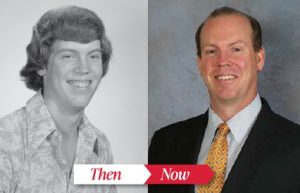
Sweeney agrees. “Brother J. Raymond Long, FSC B’43 was a big influence on my life. He would encourage us to give speeches and be succinct in our messages; that’s a lifelong learning experience. Regarding my love of the outdoors, I remember Brother John Grover, FSC B’65 and Brother Finbar McMullen, FSC B’46. We went on canoe weekend campouts. And then Father Andrew Fabian’s logic class was memorable. People always tell the story of their first day of class and how we’d sit in a seat, not assigned, but he’d go down the roster and he’d look you right in the eye and acknowledge you like he recognized you. He challenged you to think critically and if you missed a class, he would come into the Pub in the evening and find you and tap you on the shoulder and say, ‘Mr. Sweeney, you were void in my life today.’
“I would say, to the Brothers’ credit, they looked out for you, and if you did miss a couple of classes, you were getting a phone call. You were not a number at Saint Mary’s; you were an individual. My son graduated in 2010, and there were Brothers who still looked out for the students. Even though their numbers have decreased, they still try to remain very much involved and have a presence on campus.”
Cifuentes said the times he spent with the Christian Brothers were some of the highlights of his college career. “One of my favorite times is when we get to go and eat with the Brothers,” he said. “We often get invited to their home, meet them, and eat dinner with them. Brother Frank Carr, FSC B’66 always makes good food for Thanksgiving dinner. It’s interesting to listen to their history. They tell us what it was like when they were on campus.”
Buildings and facilities
Dooley acknowledges science facilities have changed dramatically since he was a student, but says he thought they were more than adequate for the needs of the time. “We had all the labs and classroom space we needed,” he said. “We had nothing to compare it to.”
He recalls historic buildings, like the Barracks (where the Heffron parking lot is now located). “It’s hard to believe anyone would live there, but it was one of the most popular places on campus. They were World War II buildings like the Student Union, which was a military building, totally adequate for the time. The dorms today are astronomically superior to what we had back in my day, but again, they felt fine at the time. We had to go down the hall for our shower and bath, and we were in a completely different situation than today.”
Beyond the former outdoor hockey rink on campus, Haydock commented on the big changes to residence hall rooms.
“Our rooms were small and sparse with bunk beds, which served us well as we were used to sharing small spaces. And there definitely were no ensuite bathrooms.”
Sweeney recalls living on the fourth floor of Saint Mary’s Hall, the “white house” by Damian Hall (which became Watters Hall), Saint Edward’s Hall (now green space), Cotter Hall (which burned down), and the Old Village (now largely community gardens and green space). Though the Toner Student Center existed during his college years, Gostomski Fieldhouse was not yet built.
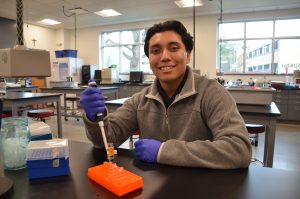
Cifuentes said he’s fortunate to have been able to study in the science building, Aquinas Hall. “The first time I saw Aquinas, I was amazed at how new it looked,” he said, “The anatomy lab offered opportunities not offered by a lot of schools.”
As a resident assistant, he knows personally how great Saint Mary’s residence halls are. “Niche has ranked us No. 1 and No. 2 in the state for our dorms,” he said, adding that — beyond the updated spaces themselves — RAs work hard to create great environments and overall memorable experiences for students.
Extracurricular activities
All four alumni highlight how much students participate/participated in intramurals.
“Everybody played intramurals and Olympic Days. That was absolutely huge,” Dooley said. “It was very, very competitive. You wanted to be No. 1 in your division. We didn’t have a lot of varsity sports — baseball, basketball, and hockey are the ones I remember, but intramurals were very competitive and very fun.”
Haydock said his claim to fame was earning the title of 1964 Saint Mary’s Shuffleboard Champion during the campus Winter Olympics.
Sweeney was on the intramural football team and remembers playing field hockey in the gym in Saint Joe’s. “A very high percentage of students participated in intramurals,” he said, “We’d support each other. The camaraderie was fantastic.”
Cifuentes says intramural sports are still very popular, but he didn’t find much time to play due to his other commitments. In addition to being a resident assistant, he volunteered at the Anthony ’59 and Sandra Adducci Family Makerspace and abroad, and served on the Student Senate for two years — first as a hall representative and then as vice president for campus affairs. He was also named Outstanding Senior this spring during Saint Mary’s Founders’ Day celebration.
His favorite activities have been The Perch and Plazapalooza, as well as Student Senate fundraising events and RA events. The LED sign of a Koi fish that he constructed in the Makerspace, he said, is a reminder of his favorite spot on campus.
Back in the ’60s, Saint Mary’s was still all male, so a popular extracurricular was the dances between Saint Mary’s men and College of Saint Teresa women across town.
“Clearly having females at Saint Mary’s was an excellent idea and certainly one of the major changes,” Dooley said, adding that he met his wife, Claudia (Drvota) CST’68, in college. At a Friday night sock hop in the gym, a friend told Dooley he was going to fix him up on Parent’s Weekend (one of the two days a year when women were allowed in the residence halls).
“I was studying at my desk when they arrived. There were five of them,” he recalls. “Lots of them came along to watch. But I didn’t ask the girl out that I was supposed to. I didn’t know which one it was. I asked another one, Claudia. And 60 years later, here we are. Our first date was Oktoberfest in La Crosse. I kissed her on top of the Ferris wheel.”
He also recalls some pretty heated snow sculpture contests. “Our hall, Aquinas (later Vlazny), built a Greek statue with speakers in it playing Greek music,” he said. “We used dump trucks to haul snow in. It was almost a full-time job. We worked on it at night for two weeks.”
Haydock remembers socializing at Holzinger Lodge and how those Saint Teresa mingler events paired up students pretty early in their college careers, leading to many marriages.
“Cars on campus weren’t allowed unless you had an exemption,” he said, which meant most students stayed around campus. He recalls having fun with Alpha Kappa Psi brothers (the business fraternity) and volunteering in the community.
Another of his claims to fame was starting the Troll newspaper with his roommate Thomas “Tom” Harvick B’67 their sophomore year. “We were co-editors, hand cranking our mimeo copies and placing them in the dorms. We were pretty proud of ourselves, but when we went to deliver the first few editions, the old editions were still there. Tom said we needed something to attract readers, and he came up with the idea of campus gossip. We recruited someone in every dorm, including Saint Teresa’s, to send us stories. We called it the ‘Hearsay’ column, and the paper took off. We also did interviews with the Brothers, administrators, and coaches. We added an ‘Opinion’ column so students could whine about something. We later had a faculty adviser assigned to try and monitor what we published. We never did get sued.”
The avid outdoorsman, Sweeney recalls canoeing and camping as a student, and the opportunity students had to learn about grilling from professors.
Different, but the same
Dooley has stayed close to the university, serving as a Trustee, helping with Centennial as a faithful benefactor, and in many other ways.
“How it hasn’t changed is the concern for the students,” he said. “That’s what the Christian Brothers are all about — an education of all people, of all economic backgrounds. That’s still the No. 1 driving motive of Saint Mary’s, and I don’t think that’s changed at all. If you go to Saint Mary’s, you’re going there because of the tremendous camaraderie that goes on on a campus of that size. You can learn so much more in a small university, for example leadership skills.
“The graduate campus is a whole different subject, and that has grown tremendously. Back in my day, you would never talk about academics and a job. That’s not the way it was thought of. Today it’s the opposite — you need to have majors that will lead to a job.”
He adds, “Alumni are still very loyal and proud they attended the school. We’ve gone through some tough times of late, but we’re not alone in that.”
Haydock, who has served as a trustee and an adjunct faculty, adds, “It’s changed because society has, and the Saint Mary’s community reflects those changes. Its mission and character has stayed the same: preparing students to become virtuous leaders serving the community. The lay faculty embodies the Lasallian heritage and continues with the Brothers this grand educational work.
“Those of us who have stayed close feel beholden to the transformational experience we had. I tell my grandkids, ‘Make college last forever, because you’ll never have that time again.’ ”
Sweeney, who worked at Saint Mary’s in development from 2007-2015, first as vice president and then director of major gifts, continues to stay active with his alma mater as well, particularly with his class, which celebrated their 45th at this year’s reunion.
“My time at Saint Mary’s is treasured, and because of it I have lifelong friends,” he said, stressing the connections built at Saint Mary’s. “During my time there, endowments were increased and the science building was built. I met with people who truly believed in Saint Mary’s and what the Christian Brothers were about.
“Academically, the institution has refined their focus so they can continue to support their academics budget-wise and draw students to the university who have an interest in those majors. I’m a believer that institutions, especially four-year colleges the size of Saint Mary’s have to adjust in today’s world. They have to meet the interests of incoming students. A lot of fine arts programs are no longer majors, although they are still present. Change is necessary for institutions to survive financially and to grow in their expertise of what they’re offering.
“Saint Mary’s is a university, and back then it was a college. Today they have doctoral programs, programs for training nurses, and growth of online programs. I hope it continues to remain strong so the institution remains for many many years to come.”
Cifuentes can’t speak to how Saint Mary’s has changed, but he believes the close relationships, caring faculty, and Lasallian influence make Saint Mary’s special.
“The small size allows us to form deeper relationships with our professors,” he said. “We have the chance to talk with people who are experts in their fields, who talk to us individually. If I were talking to people looking for a college to go to, that’s what I would advertise the most.”
He also reflects on benefactors who have so generously helped the university meet the needs of its students. “They loved this campus so much. Sophomore year, I realized how many buildings and spaces here were built through donations. I thought, ‘They must have loved their time here. Will I feel that way when I’m done?’ Now I understand; this is a good space for you to make lifetime memories, and a lot of that is due to the donors who walked so we can run. I feel blessed that they cared so much. I’m happy to contribute however I can to show my thanks.”